01 / PROJECT FIT
Application & selection
Vertical hanging can be considered for long parts such as aluminium profiles. Suitability depends on part dimensions, fixtures and site conditions.
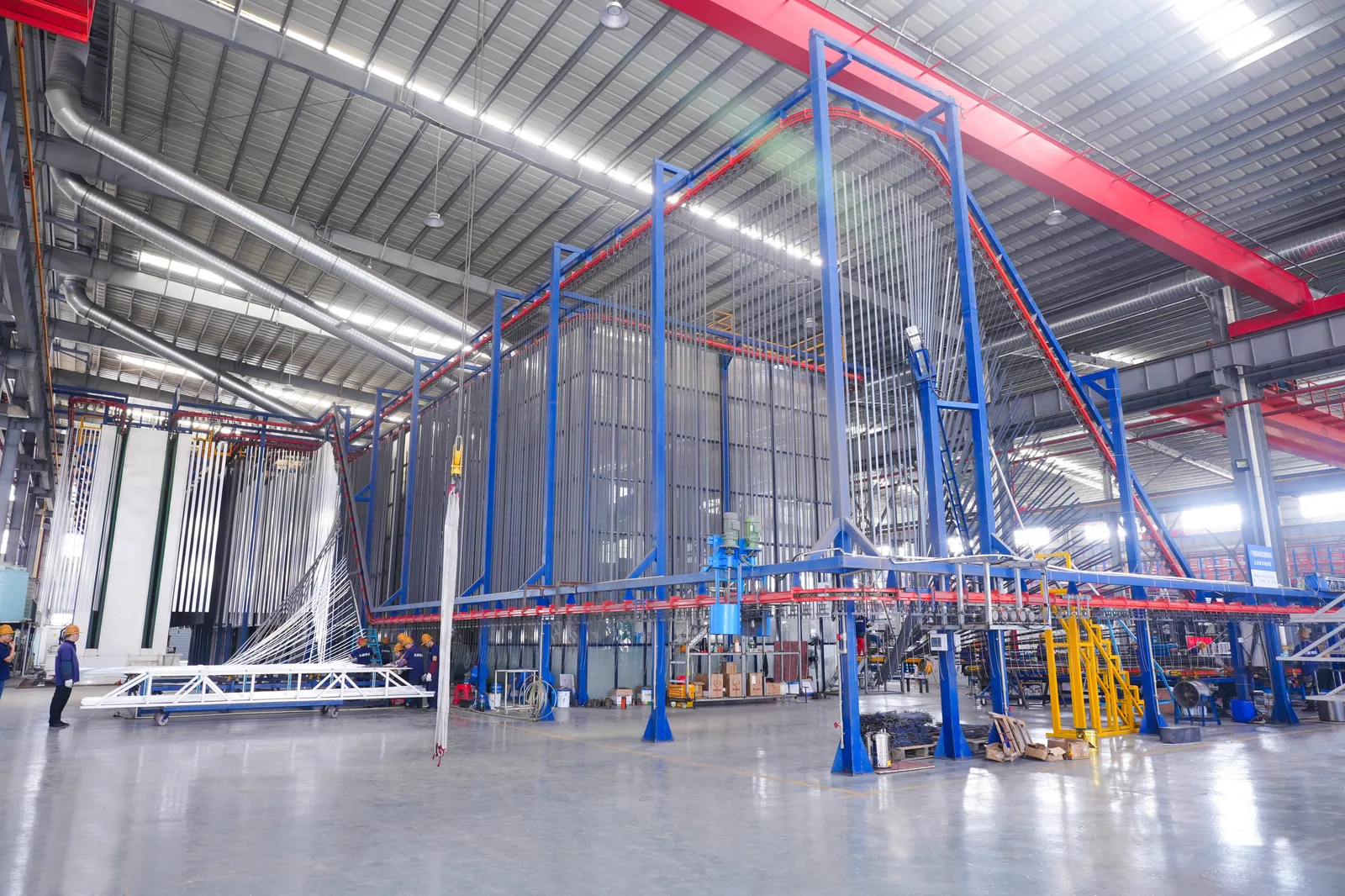
Plan a vertical hanging line around long profiles, building clearance and production targets.
Request a quote →View site galleryVertical hanging can be considered for long parts such as aluminium profiles. Suitability depends on part dimensions, fixtures and site conditions.
A typical sequence includes cascade pretreatment, drying, powder application and recovery, curing, and loading and unloading conveyors. Configuration is confirmed for each project.
Process, equipment and service scope are confirmed for each project.
Share maximum profile length and weight, target output, clear height, utilities and colour requirements.
Discuss your project →Process, equipment and service scope are confirmed for each project.
Long parts, profiles, curtain-wall sections, railings — and any part that must be coated on both faces in a single pass. Parts hang vertically, gravity keeps the hanger stable, and both faces are coated simultaneously, which makes film-thickness consistency easier to hold than on a horizontal line.
The precondition is clear height. Usable height is approximately the longest part plus hanger, conveyor safety margin and maintenance access. Where height is short, it is better to move to a horizontal or segmented layout than to cut into the safety margin.
Maximum part length sets oven height and building clearance; hanger pitch sets throughput; loading method (manual, semi-automatic or automatic) sets the footprint and manpower at both ends. These three constrain each other and must be calculated together.
A common mistake in profile plants is to size the height for the longest part but calculate takt on the shortest. The line ends up tall and still cannot deliver output. Sizing around the main product range, with long parts run in batches or bypass, is the more workable approach.
Scope covers tower or bridge steelwork, lift or swing-bar conveying, anti-sway design, booth and curing oven, and integrated controls.
Long parts sway while moving. Anti-sway is not an accessory; it directly determines how stable the gun-to-part distance stays, and therefore whether film thickness is uniform.
How much clear height is needed?
Calculated as maximum part length plus hanger, conveyor margin and maintenance access. We do not fix line height before the actual clear height is measured.
Can long and short parts share one line?
Yes, with compatible hanger design, but the takt should be set for the main product. Long parts run separately in batches, otherwise output is dragged down by the slowest item.
Is a vertical line much more expensive?
Usually yes — mainly in steelwork, oven height and anti-sway mechanisms. The actual difference depends on height and configuration and should be compared case by case.
Can we start with just the booth and oven?
Phasing is possible, but oven height is tightly coupled to building structure. We recommend reserving the full height and foundations from the beginning.